As an Amazon Associate, Wishpile earns from qualifying purchases.
A good hiding place has three qualities: it's boring, it's inconvenient, and it's already full of something else. Anywhere that's empty, interesting, or visited before Christmas will fail, no matter how clever it feels when you put the bag down.
That's the whole theory. Below are the specific spots that pass the test, the ones that don't, and then the part most guides skip: the three ways people get caught that have nothing at all to do with where the box is.
Why most hiding places fail
Your family knows your house better than you think, and a determined snooper has one enormous advantage over you: time. You hide a gift once, for thirty seconds, in a hurry. They have six weeks of unsupervised afternoons.
So the places that fail are the obvious ones, and they fail for predictable reasons:
- The top shelf of your closet. The single most-checked spot in the house. It's the first place anyone looks because it's the first place anyone hides.
- Under the bed. No cover, and it gets vacuumed.
- The car trunk. Fine, unless somebody else ever drives that car, loads groceries, or needs the spare tire.
- Your wardrobe or dresser drawers. Someone is putting laundry away in there, possibly a person you're buying for.
- The garage, loose on a shelf. Visible from the door, and gift bags are shaped like gift bags from thirty feet away.
Hiding places that actually work
Each of these passes all three tests. Boring, inconvenient, already full.
- Luggage, inside other luggage. Suitcases are stored closed, nobody opens them between vacations, and a suitcase inside a bigger suitcase is two barriers deep. The strongest spot in most homes.
- Under-bed storage bags of out-of-season clothes. Not the floor under the bed. The sealed bag of summer things, with the gift at the bottom. If you don't have any, zip-up fabric under-bed bags work well; put the gift under the clothes, so the little window shows nothing but sweaters.
- A labeled box of profoundly dull paperwork. Tax returns, old bank statements, instruction manuals, cables. Write "2019 TAXES" on it in marker. Nobody has ever opened that box voluntarily. Plain cardboard file boxes with lids look exactly as boring as they need to.
- The high cabinet above the fridge or over the washer. Requires a chair, which is exactly the kind of inconvenience that protects you.
- Someone else's house. A neighbor's garage, your parents' spare room, a friend's basement. Unbeatable, since the search space isn't your house, and worth it for the big or awkwardly shaped gift.
- A locked filing cabinet or a toolbox. Dull on the outside and genuinely closed, which is a rare combination. No cabinet? A locking file box with a combination lock fits on a closet shelf, and there's no key for anyone to find.
- Inside a pillowcase on the linen-closet shelf, under the spare sheets. Works for soft and flat things. Nobody reaches past the front stack.
Four rules that matter more than the spot:
- Don't pick a place you'll need before Christmas. The suitcase works until someone books a trip in November.
- Kill the rattle. Put the box inside a soft bag. Plenty of surprises are heard before they are seen. Fabric drawstring gift bags do it twice over: they muffle the box now, and on Christmas Eve they're the wrapping.
- Take the receipt out of the bag. If the bag is found, the price being found with it makes everything worse.
- Write down where you put it. Not optional. Plenty of gifts are lost by the buyer rather than found by the recipient, and a gift discovered in March is worse than one discovered in December.
The three ways people get caught anyway
Here's the uncomfortable part. In most houses the box is not what gives it away.
1. The delivery
Most gifts arrive at your door now, which means the hiding happens after a courier has already announced it. The leaks are: the box on the step with the retailer's name printed on it, the delivery text to a phone that's lying on the kitchen counter, and the "your package has arrived" notification on a shared tablet.
What works:
- Use a separate email address for gift orders. This is the single highest-value trick on this page, it takes two minutes, and it doesn't depend on any one retailer's settings. Order confirmations, shipping updates, and the inevitable "how did we do?" survey all land somewhere nobody else reads.
- Collect it instead of receiving it. Lockers, store pickup, or your workplace. Nothing arrives at the house at all.
- Have it sent to the neighbor you already trade parcels with.
2. The paper trail
Worth a minute of thought, because it's invisible until it isn't:
- Bank and card alerts that name the store, on a phone that gets handed to a child.
- A shared retailer account, where your order history and "buy it again" row are plainly visible to everyone who uses it.
- Browser history and autofill on the family laptop, which will happily suggest the product page you visited at 11pm.
- A gift list in a shared Drive or a Notes app syncing to a family iPad. This one is the quiet killer, and it's the subject of the next section.
3. The list itself
If you keep a gift list, that list is now the most interesting document in your household. A spreadsheet in a shared Drive, or a note that syncs to a tablet in the living room, undoes every suitcase-inside-a-suitcase you ever pulled off.
And a spreadsheet has no idea who's reading it. You cannot show your partner the rows for their mother while hiding the rows for them. Hidden rows unhide with one click. A second secret copy means two versions of the truth, which is how a gift gets bought twice. (If a sheet is your system, the honest version of that template covers what it can and can't do.)
How to hide the list
This is the part we actually built. In Wishpile, a gift list is private by default - it's your plan, and nobody sees it unless you deliberately bring them in. Three things follow from that:
Your partner is the one real exception, and there's a switch for it. If you plan gifts together in a household, you can both see each other's lists, which is the point. So when your partner is also someone you're buying for, you link their entry on your list to their account. Every gift you plan for them then disappears from their view, including the photos, and their reminders leave it out too. Not greyed out. Gone, with no hint that anything is there.
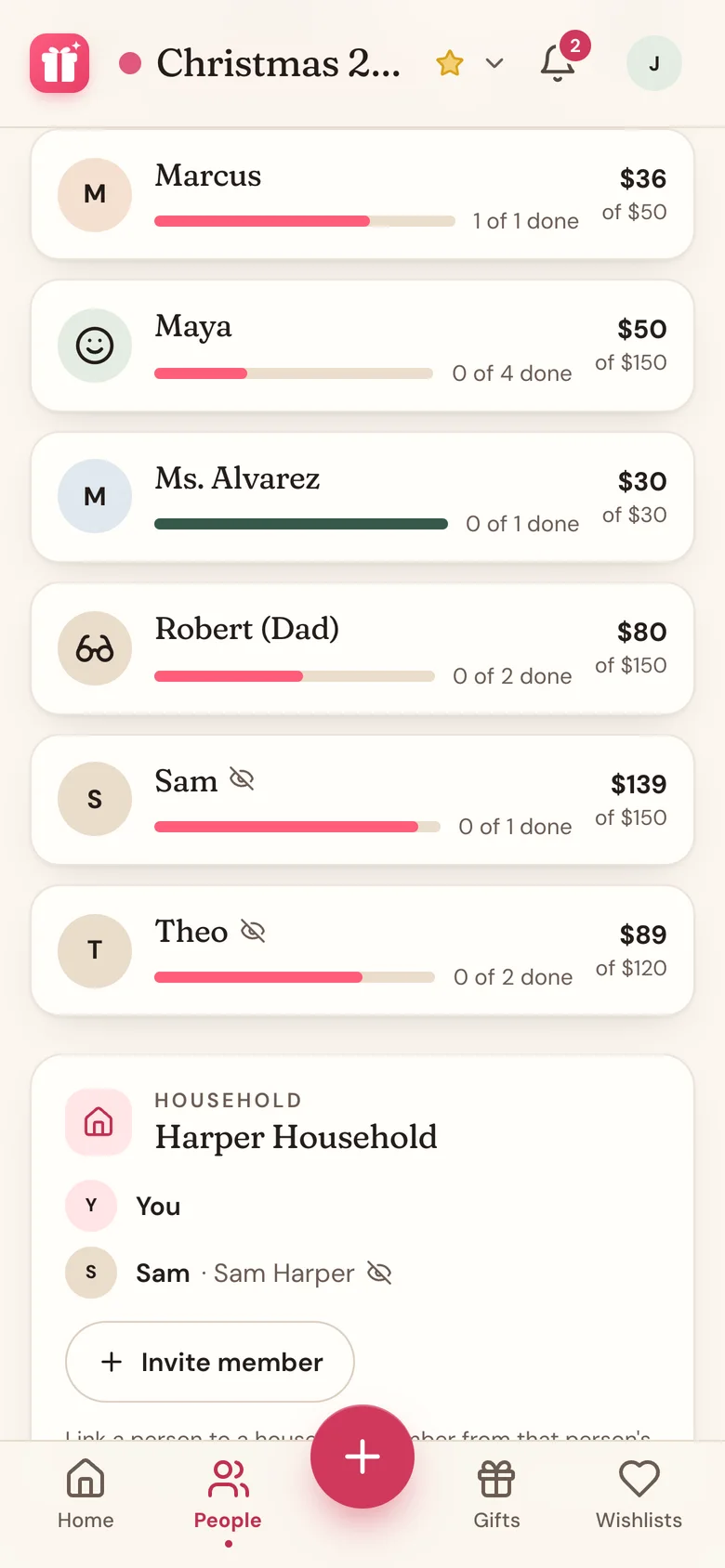
It only hides your gifts from them. If they're buying for you too, they link you on their own list, and neither of you can see the other's plans.
Amounts can disappear from the screen. Planning on the sofa with someone reading over your shoulder? Tap the eye icon on the Budget card and every total on Home and People turns into dots. It's per-device, so it doesn't change anything for anyone else.
A coordinator can never be the recipient. If you add a coordinator to help with one gift or one person, they see only that, and the person a gift is for can never be made a coordinator for it. An invite sent to them never takes effect.
And on the other side of it, your own wishlist never shows you claims. People can take things off your list and coordinate with each other, and you see every item as available, so your family can shop properly without you catching on. (That same mechanic is what prevents duplicate gifts, too.)
One last thing: hide from them, not from yourself
The most common hiding failure isn't a kid finding a box. It's you, on December 23rd, standing in the hallway with wrapping paper and no idea which suitcase.
So whatever system you use, write the spot down next to the gift. In Wishpile the notes field on a gift takes it, and six words is plenty: "hall closet, inside the red duffel." Thirty seconds now, and wrapping night is a list instead of a search party.
Common questions
Where is the best place to hide Christmas presents?
Inside luggage that's stored closed, especially a case inside a larger case. It's boring, closed, awkward to get into, and nobody opens it between trips. A dull labeled box of paperwork is the runner-up.
Where should you never hide Christmas presents?
The top shelf of your closet, under the bed, in a dresser drawer, or anywhere you'll need before Christmas. The closet shelf is the first place everyone looks, precisely because it's the first place everyone hides.
How do I stop gift deliveries from giving away a surprise?
Use a separate email address for gift orders, and collect parcels from a locker, a store, or your workplace rather than having them arrive at home. The notification usually gives you away before the box does.
How do I hide a gift from my partner if we plan Christmas together?
You need something that can hide specific gifts from specific people, which a shared spreadsheet can't do. In Wishpile, linking your partner's entry on your list to their account removes every gift you've planned for them from their view entirely.
How do I keep kids from finding presents?
Hide the delivery, not just the box - kids are far more likely to see a parcel on the step or a notification on a tablet than to find a sealed case in the back of a closet. Then pick a spot that's inconvenient to reach and already full of something dull.