It's Christmas morning. Your son opens the LEGO set he's been talking about since September. Pure joy. Twenty minutes later he opens the second, identical LEGO set, this one from his grandmother, and everyone does the polite laugh while you mentally add "return, with receipt, in the week between Christmas and New Year's" to your to-do list.
Duplicate gifts are the most preventable disaster in gift-giving, and also one of the most common. Here's why they keep happening - and how to make them basically impossible.
Why duplicates happen
Every duplicate gift is a communication failure wearing a bow. It takes one of three forms:
Two givers, one idea. The kid mentioned the LEGO set to everyone, because kids broadcast their wishes to any adult in range. Both grandma and you heard it. Neither of you knew the other heard it.
One giver, no memory. You bought the book in October. You hid it well - so well that in December, past-you having left no note, you bought it again. (This one stings the most because both purchases were you.)
A wishlist with no state. The family shares ideas by group text, so everyone knows what Emma wants - but nobody knows what's already been bought. A wishlist that doesn't track claims isn't a system; it's a suggestion box with a race condition.
Notice what's not on the list: carelessness. Duplicates don't happen because people don't pay attention. They happen because there is no shared source of truth, so everyone is making decisions on private information.
How do you stop buying duplicate gifts?
You stop buying duplicate gifts by replacing memory and group texts with one list per person that records what has already been bought - and by making claims visible to every giver except the person receiving the gift. Those two rules remove both kinds of duplicate: the one where two people buy the same thing, and the one where you buy it twice yourself.
The fix, in three habits
1. One list per person, and it's the only list
Keep a running gift list for each person you buy for - one place where ideas, purchases, and "already owns it" knowledge all live. The moment you buy something, mark it bought in the list, not in your memory. When December-you wonders "did I already get the book?", the answer should be a glance, not an archaeological dig through the closet.
This alone eliminates the self-duplicate. It also quietly fixes the related disaster: the gift you bought, hid, forgot, and found in March.
2. A shared wishlist with secret claims
For families and groups, the fix has to be shared - and this is where most systems break. A group text or shared doc tells everyone what Emma wants, but the second requirement is the one that matters: when someone commits to a gift, everyone else needs to see it's taken - except Emma.
That "except Emma" clause is why spreadsheets and group texts fail. You can't hide a row from one person in the family spreadsheet. So families either spoil the surprise or keep the claims verbal, and verbal claims are how two people end up in different stores buying the same air fryer.
The mechanics you want: everyone posts wishes to one shared list; anyone buying claims the item; claims are visible to every other giver and invisible to the recipient. Once claiming is one tap, people actually do it, and duplicates stop at the source.
3. Check the list before checkout, every time
The last habit is the smallest: make "check the list" part of buying, like checking your mirrors before changing lanes. Standing in the store, item in hand - open the list. Is it claimed? Did you already buy them something in this price range? Is there a better idea sitting there that you captured in July and forgot about?
Ten seconds. It prevents duplicates, but it also prevents the sneakier failure: buying a fine gift when a great one was already on the list.
What claiming a gift actually looks like
Here is the same wishlist - Jules Harper's - seen three ways. It is the whole system in three screens.
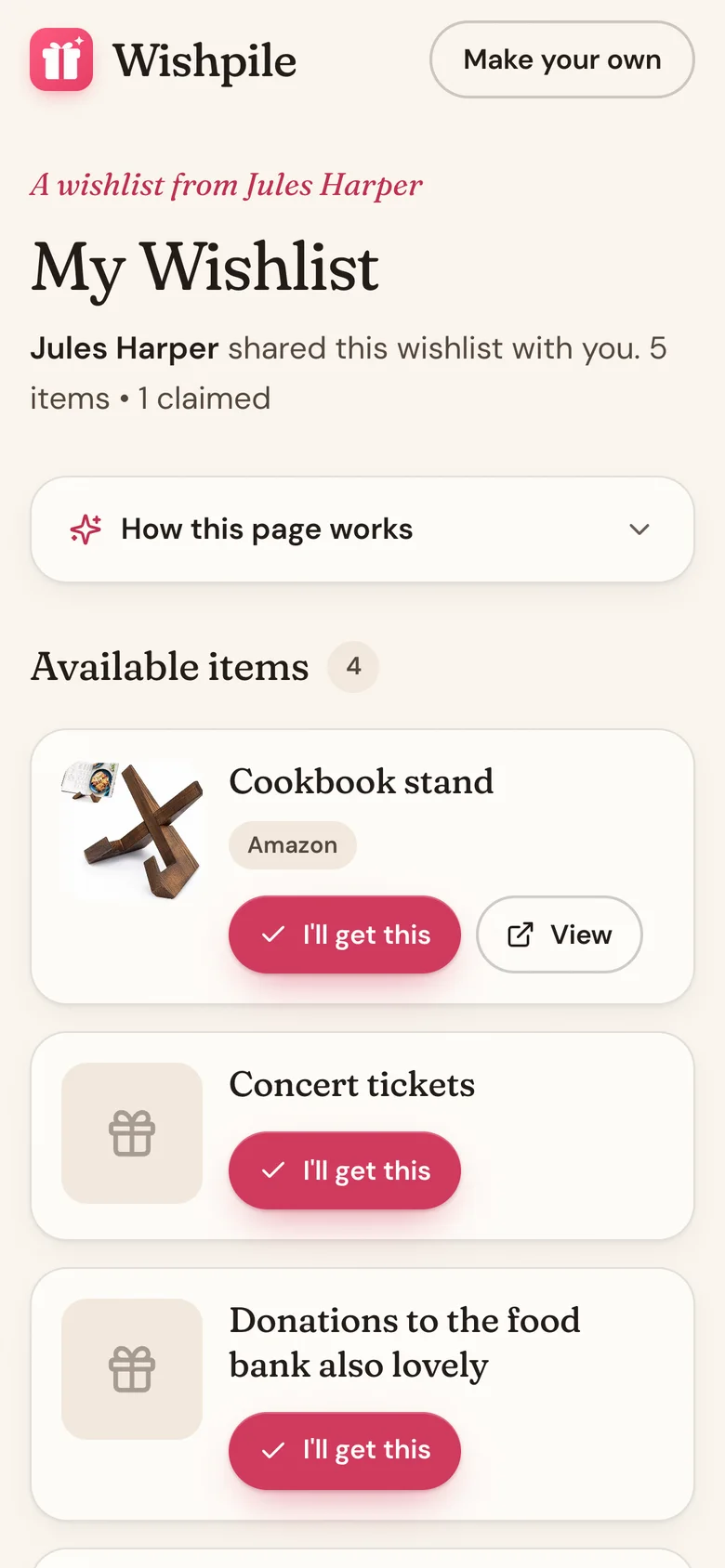
1. Jules's list, as everyone else sees it. Open the link she sent and every wish is there under Available items, each with an I'll get this button. The line at the top reads "5 items • 1 claimed": someone has already taken one, and it has moved down to Already claimed. No account, no sign-up, nothing to install.
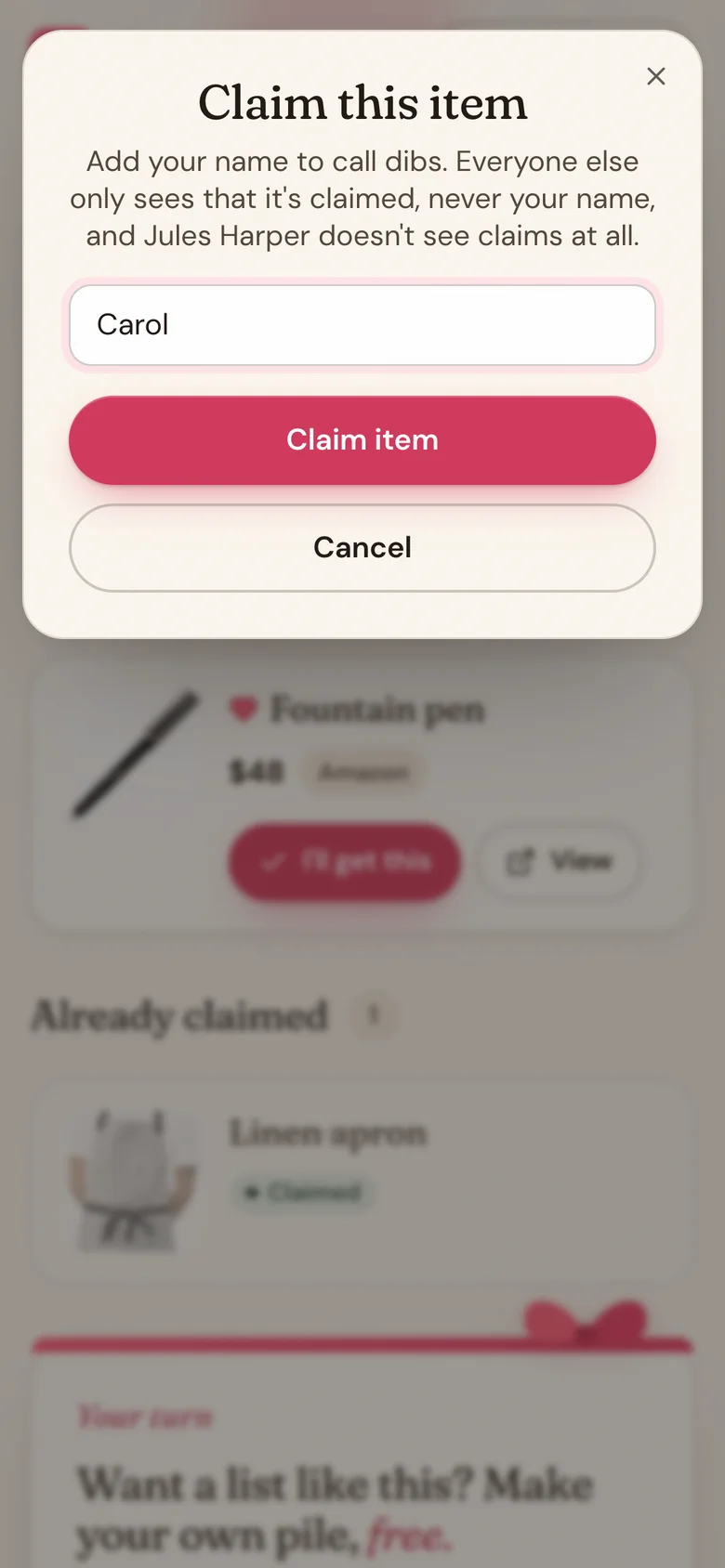
2. Claiming one. Tap I'll get this, type your name, tap Claim item. No message to send and nobody to check with. The name is only so you can undo it later - every other giver just sees Claimed, never who claimed it.
3. The same list, as Jules sees it. Five items, no claim marks, no count, no spoiler. She cannot see who is buying what, and she cannot see that anything has been bought at all.
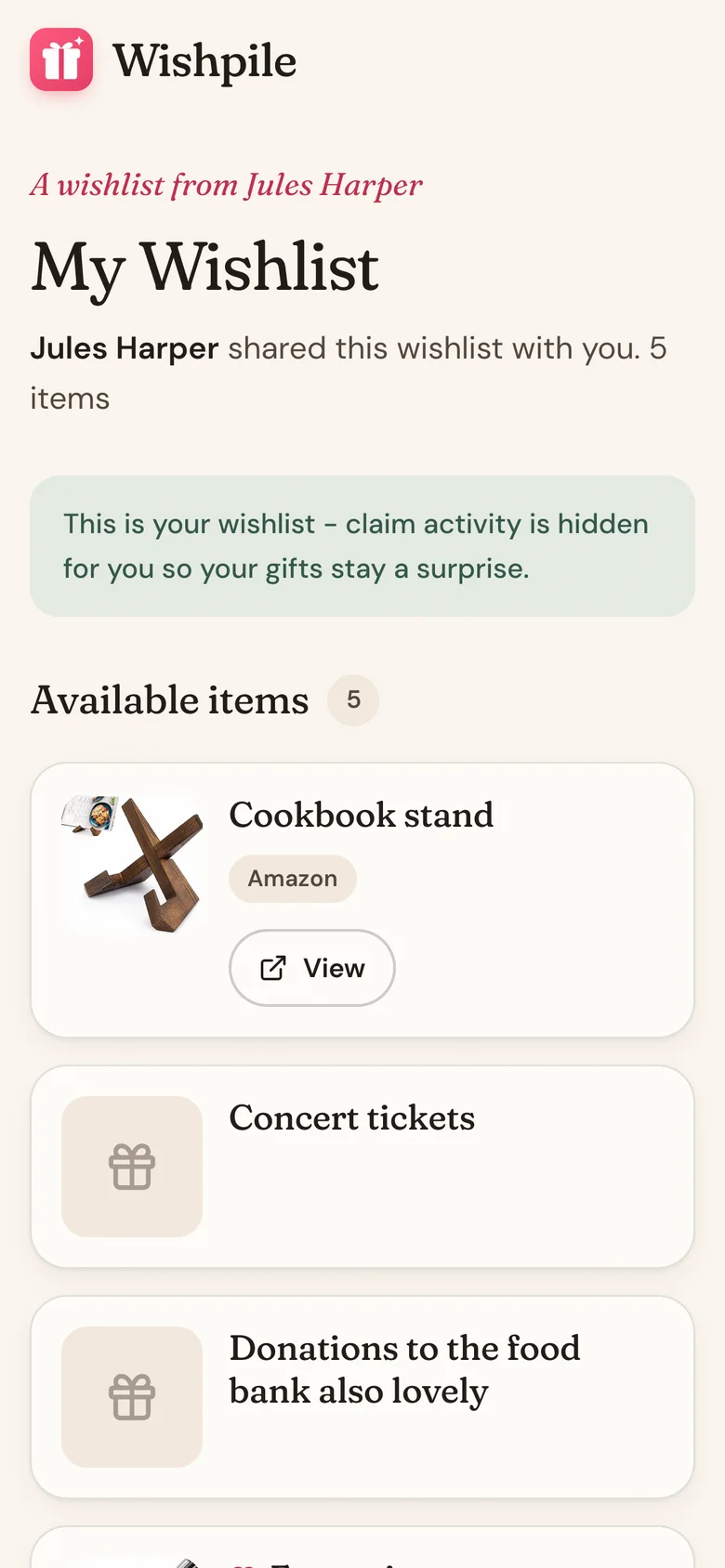
That third screen is the whole trick. Every giver works from the same information, and the person receiving works from less.
What this looks like when it's easy
We built Wishpile around exactly these three habits, because we got tired of duct-taping them out of spreadsheets:
- Every person gets a gift list, and every gift moves through idea, bought, wrapped, done - so you always know what's already handled (and where you are on wrapping duty).
- Family groups share wishlists with secret claims built in: claim a gift and every other giver sees it's taken, while the wishlist owner sees nothing at all.
- It lives on your phone, so "check the list" works in the store aisle, not just at your desk.
If December is where this bites hardest, the Christmas gift organizer is the same thing with a countdown attached, and we compared the free options honestly in the best gift tracker app roundup.
However you run it, the principle is the same: duplicates are a system problem, not a people problem. Give your family one source of truth with secret claims, and the only surprise on Christmas morning will be the good kind.